Chinese name: Therizinosaurus
Latin name: Therizinosaurus
Age of existence: Late Cretaceous
Fossil origin: Mongolia, Kazakhstan
Physical characteristics: 8-11 meters in length
Diet: Omnivorous
Type: Theropod
Meaning: A lizard with a long handle and a large scythe.
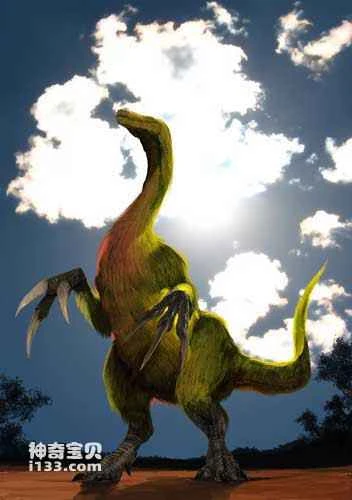
In 1923, paleontologists discovered a massive fossilized forearm skeleton and some claw fossils in Mongolia. The forearm bone was a staggering 2.5 meters long, and some claws were about 75 centimeters long—resembling a long-handled scythe used for weeding. The discoverers named it "Therizinosaurus," initially classifying it as a giant sea turtle. It wasn't until 1990, with the discovery of more complete fossils, that it was revealed that Therizinosaurus was an unknown, enormous dinosaur.
Therizinosaurus had a very strange appearance: its small head resembled that of a herbivore, but its forelimbs with huge claws resembled those of a ferocious carnivore. Its belly was bloated and fat, it walked slowly, and its legs were wide and short, making it a "four-not-like" creature in the dinosaur world.
Therizinosaurus, with its unique appearance, was a large, bipedal theropod dinosaur that lived in the Gobi Desert of Mongolia during the Late Cretaceous period (of course, the Gobi Desert at that time was not the barren, sandy wasteland it is today, but a lush and fertile land with abundant vegetation). Therizinosaurus had a short and relatively rigid tail due to the presence of bony supports called clubs on its tailbone. Skeletally, it was more evolved than other therizinosaurs; the type species was 9.6 meters long and weighed 6.2 tons. It had long forelimbs with sharp claws on its fingers, as well as robust hind limbs with claws on its large toes. It had a short tail and likely possessed primitive feathers. Regarding its locomotion, some paleontologists believe that its forelimbs and hind limbs were of similar length, suggesting a movement similar to that of a gorilla or clawed beast. However, many more paleontologists believe it was not quadrupedal, as the structure of its forelimbs was unsuitable for supporting its weight, and its claws would have been cumbersome.
Because the skeletal fossils of Therizinosaurus are incomplete, many of its features remain speculative and await further development and exploration.